It's 1 a.m. The balance sheet is off — again, by a different amount than an hour ago. In a drawer — and a downloads folder — more than a year of unprocessed receipts and invoices. If you run a small studio, you may know this night.
A friend of mine — a boutique design studio owner — knew it every year, while paying for bookkeeping software the whole time. So over two weekends last month, with an AI agent doing the heavy lifting, we filed the overdue return, cleared the entire year-plus backlog, and rebuilt the books into an AI-friendly system. We call it Project Quince, and it changed my friend's mind about what small-business bookkeeping tool should be:
You don't need to subscribe to bookkeeping software. With an AI agent, a small studio can own a system tailored to its needs and to the habits of its owner — and its accountant. Free to run, with books you can trust to the cent.
Two questions worth un-asking
"Which bookkeeping software should I subscribe to?" The subscription was never buying software — it was renting permission to work inside someone else's workflow. A SaaS product has to average across a million businesses; your studio isn't average, and every habit that doesn't fit becomes friction you pay for monthly.
"Fine — then which one is best?" Also the wrong question. The best bookkeeping system is the one tailored to your business: your banks, your project codes, the way you and your accountant actually work.
There's a quieter problem too, and SaaS and Excel share it: the books end up locked in a format that resists analysis. Which client pays slowest? How much tax should be set aside this quarter? Every answer means an export, a report request, an email thread — someone else's schedule.
What the project built
Project Quince turned the books into a system the studio owns. Bank statements — the PDFs the bank already issues — drop into a folder; Python parsers read them; every transaction lands in one local database on the studio's computer. Receipts are capture-and-forget: photograph one into a Google Drive folder; the system reads it on-device, files it, and matches it to the transaction that paid for it. The old books came along too — exported once from the subscription software, imported, kept.
Because the books are one clean database rather than screens in a vendor's app, they can be restructured and visualized any way the owner likes, without ever losing a cent of data.
And the part that changes the accountant equation: books in a database are AI-readable. Point a large language model at them and you have an analyst on call — cash flow by client, tax set-asides, the invoice that's quietly sixty days overdue. On your terms: run a local model and nothing leaves the machine, or share a deliberate slice with a cloud model when you choose. Either way, you decide what leaves. With a SaaS, that decision was never yours to make.
Why my friend trusts it more, not less
Books assembled by AI-written code — why trust them? Because the system must prove itself twice — the two check points in the diagram below — and refuses to proceed when it can't.
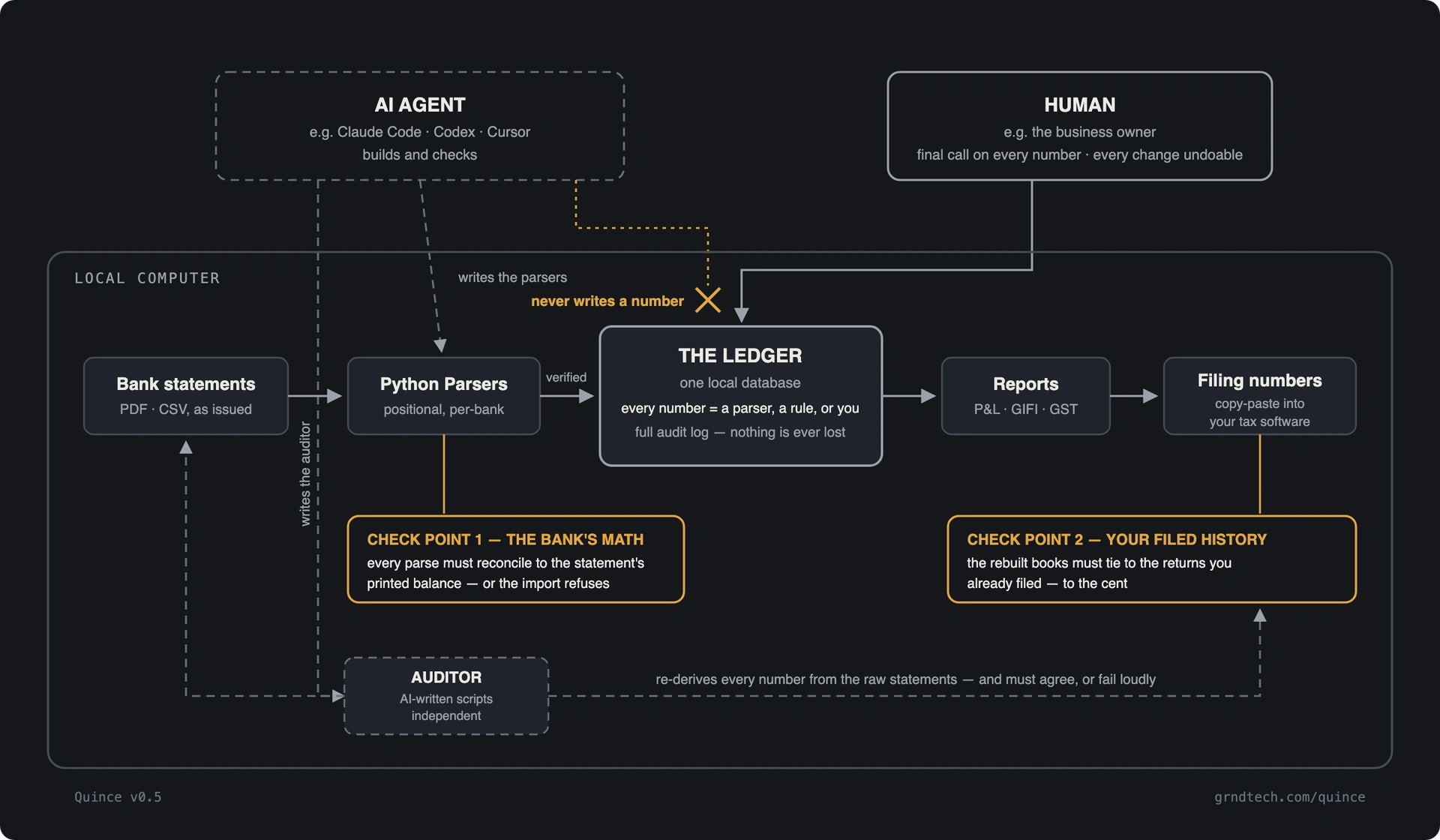
Check point one: every imported statement must reconcile to the bank's own printed balance. If a single line is misread, the import fails loudly instead of guessing. Check point two: the rebuilt books must tie to the returns already filed in past years — to the cent.
Those checks caught what the paid tools never did: one bank's CSV export was missing transactions that the PDF statements showed — and the reconcile check exposed the gap. At filing time, the system's numbers matched commercial tax software to within a dollar.
One rule makes this safe: the AI never writes a number. Models built the parsers and the audit scripts, but every figure in the ledger comes from a parser, a rule, or a human decision — same inputs, same books, every change undoable. That's why hallucination doesn't keep me up at night: the model drafts and checks; it never touches the ledger.
What the project has verified — so far
Working through a real studio's real books, Project Quince showed how fast AI support turns this around: years of books rebuilt from raw statements, a year-plus backlog of receipts and invoices cleared, and an overdue return out the door — in two weekends. Every import reconciled, the results tied to prior filings to the cent, the final figures prepared in the same line order as commercial tax software, reviewed by a human and copied across. The accountant still reviews before filing — but now they review a clean, defensible set of books instead of a shoebox.
What came out of the project, we want to share — so you can build on top of it instead of starting from zero. Quince v0.5 is free and open source (Apache 2.0) — not an installer yet, but the working code plus a map written for AI agents. Clone it, open it in Claude Code, Cursor, or Codex, tell it about your banks, and it tailors the system to you — writing new statement parsers where needed, under the house rule: reconcile, or refuse. Our first working version took two weekends; starting from ours, yours should take less.
The fire is out — the overdue return filed, the books current. What changed is the quiet afterwards: no more scrambling to remember which transaction belongs to which project or receipt. The system remembers, and the AI checks, compares, and suggests when asked — an optional supporting role, with the human deciding. My friend's verdict: "so much better than pulling an all-nighter trying to balance the balance sheet." Somewhere along the way, playing with the books became enjoyable.
Preview it at grndtech.com/quince — screenshots and what's inside.
Download the code at github.com/maxli552/quince — Apache 2.0, free to use and adapt.