- “Summarise this 100-page report in five bullets.” Lots of input, little output: watch input volume and price.
- “Turn this brief into a detailed proposal.” Substantial generation: watch output price and answer length. Heavy reasoning can add output charges too.
- “Answer ten questions about this same report.” Repeated input: watch cache reuse and hit rate.
What you are paying for
Input is what AI receives: instructions, documents, conversation history and tool results. Output is what it generates, usually at a higher rate per token. Some models also bill internal reasoning as output, so a short visible answer can still involve many billable tokens.
Cache write = prepare and save. Cache read = reuse.
On the first question about a report, the provider processes the report. If caching is enabled and the report qualifies, it also saves that processing work. Saving it is a cache write.
On a later question, the provider can reuse that saved work instead of processing the same report again. Reusing it is a cache read, also called a cache hit.
Neither means writing or reading the answer. The model generates—and charges for—a new answer each time. New material is billed as ordinary input, or as a cache write if it is saved for reuse.
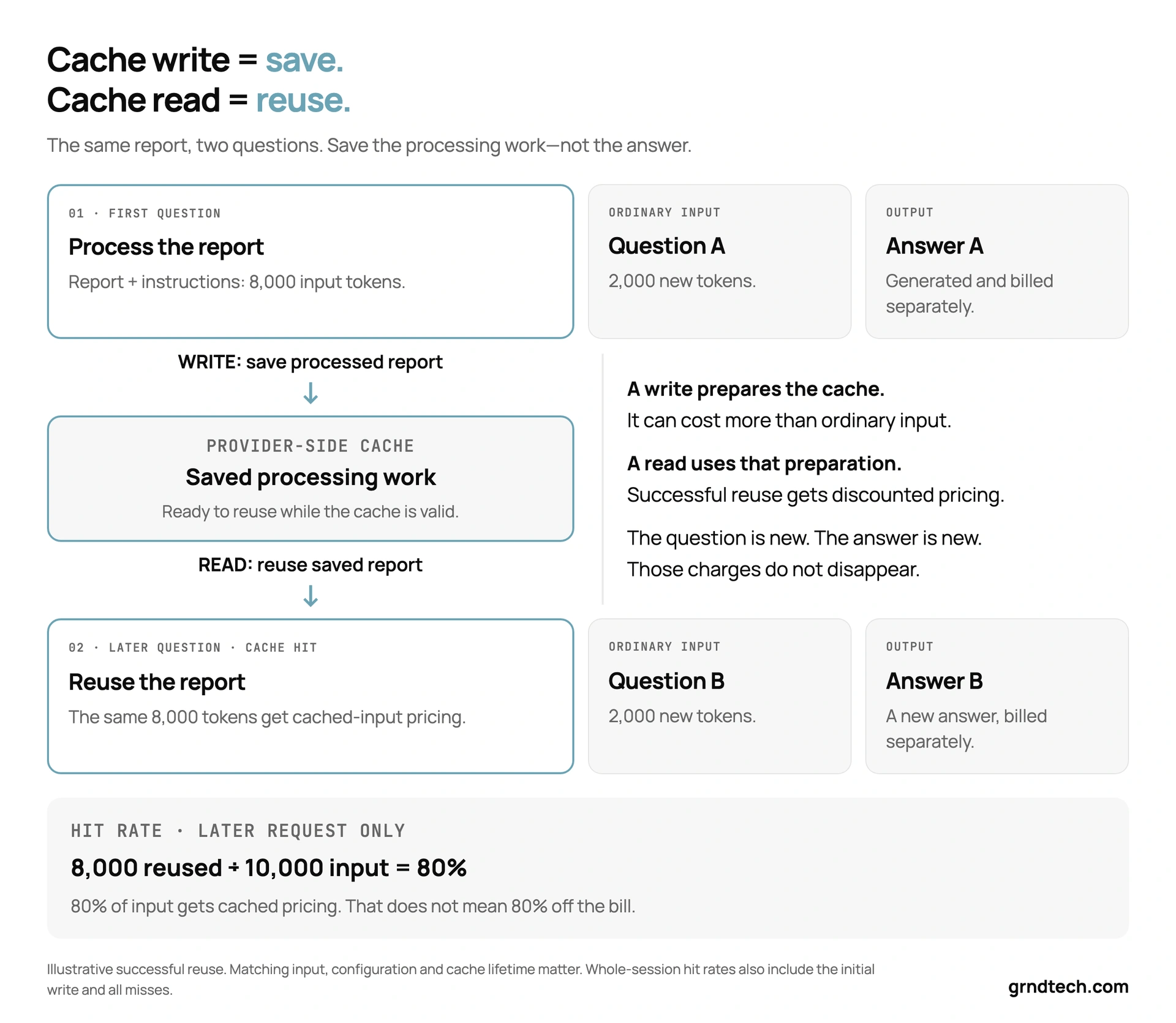
Illustrative successful reuse, not a guarantee of a hit on the second call. Cache configuration, matching input and retention all matter.
Isn't a cache write just input? Why can it cost more?
Yes—a cache write is still input, billed differently because the provider is preparing it for reuse. Ordinary input pays for processing material for the current request. A cache write includes that processing plus saving the resulting internal state for later requests.
Saving the original report alone would not avoid processing it again. The useful thing to keep is the intermediate results of that processing. Retaining and managing this state across requests uses memory or storage; a later cache read can reuse it instead of repeating that work.
Some providers charge a write premium for this service; others include it in ordinary input pricing or charge separately for storage. The exact premium is a pricing policy, not a universal technical requirement. A 1.25× rate does not mean saving the state necessarily costs the provider exactly 25% more.
What that means in money
Suppose processing a report normally costs 10 cents. With an illustrative 1.25× write rate and a 90% read discount:
- Prepare and save it: 12.5 cents for the cache write.
- Reuse it on the next question: 1 cent for the cache read.
- Ten questions using one write and nine successful reads: 21.5 cents for the report, instead of $1 to process it ten times.
New questions, generated answers and any separate storage fees are outside these figures. The 12.5-cent write replaces the ordinary 10-cent input charge; it is not added on top.
You pay slightly more initially to pay much less when you reuse the material. A cache written once and never reused may save nothing. If it expires or the shared material changes, another write may be needed.
The cache hit rate is what turns a discount into savings
A provider might advertise a 90% cache-read discount. That does not mean your bill falls by 90%.
Your input-token cache hit rate is:
Tokens successfully reused ÷ total input tokens.
In the diagram's later request, 8,000 of 10,000 input tokens are reused: an 80% hit rate. That means 80% of the input receives cached pricing—not that the whole bill falls by 80%.
At a 90% read discount, reusing 80% of your input cuts that request's input cost by 72%, assuming the other 20% is ordinary input. Output, initial writes and storage still need paying for. For a whole-session hit rate, include the initial write and every miss in the total input count.
Is cache hit rate the biggest cost factor?
It can be, when repeated input dominates your bill: document conversations and long-running agents are common examples. If generated text or reasoning dominates, caching only reduces the smaller input portion.
Do not chase hit rate alone. A shorter request with no cache hits may cost less than a large, heavily cached one.
How provider rules differ
As checked on 12 September 2026:
- Anthropic: writes cost 1.25× ordinary input for five-minute retention or 2× for one hour. Reads cost 10% on most models; Fable 5.1 reads cost 2.5%.
- OpenAI: GPT-5.6 and later charge 1.25× for writes and 10% for reads. Earlier models differ. Automatic caching does not mean free writes.
- Gemini: implicit caching is available on supported models; explicit caches also incur storage charges. For Pro Preview, keeping one million tokens cached for eight hours costs $36 in storage alone.
- DeepSeek: the published rates distinguish cache hits and misses, with no separate write or storage fee listed. Hits are best-effort, not guaranteed.
Eligibility, cache lifetime and request structure all affect whether reuse actually happens. The API's usage report tells you how many tokens received cached pricing; a repeated document alone is not proof.
The current price ladder
The chart compares token rates, not model quality or cost per completed task. The full bill combines ordinary input, cache writes, cache reads and billable output across all calls, plus any storage or tool fees. Count reasoning once if it is already included in output.
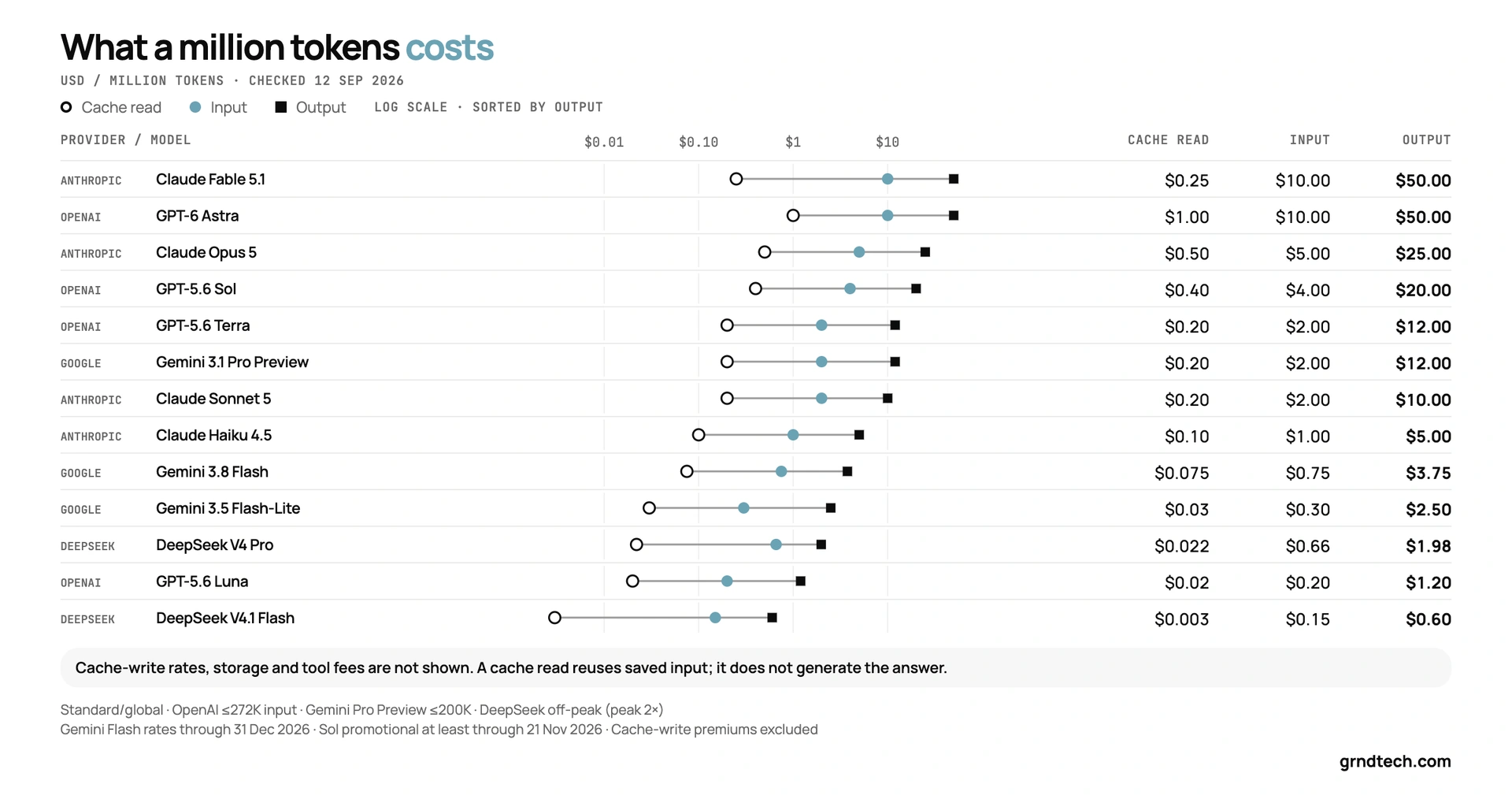
USD per million tokens, checked 12 September 2026. Standard/global rates; cache writes, storage and tool fees are not plotted.
Conditions that materially change the comparison:
- Anthropic / Claude: standard rates shown, not fast mode. Cache-write premiums are separate from the plotted read rates; Fable 5.1's read rate is 2.5% of ordinary input, versus 10% for the other plotted Claude models.
- OpenAI: chart rates apply up to 272,000 input tokens. Above that, input/cache rates double and output rises 50% for the full request. Sol's promotional rates last at least through 21 November 2026.
- Gemini Pro Preview: above 200,000 input tokens, input/cached-input/output rates change from $2/$0.20/$12 to $4/$0.40/$18. Gemini 3.8 Flash's plotted rates are scheduled to double on 1 January 2027.
- DeepSeek: off-peak rates shown; prices double during 01:00–04:00 and 06:00–10:00 UTC, Monday–Friday. Flash now serves V4.1.
Three useful habits
- Send only useful context. Keep repeated instructions and documents stable, but do not add material just to improve a cache statistic.
- Match the output to the job. Ask for the length you need and use an appropriate reasoning effort where supported. Check that a shorter or cheaper run still produces a useful result.
- Measure and limit the whole task. Include retries and tool calls, inspect actual cache usage, and set call or spending limits where available. A cheap call repeated unnecessarily is still waste.
Input-heavy work needs attention to input volume. Output-heavy work needs attention to generation and reasoning. Repeated-context work needs attention to cache reuse. Start with the part that dominates your own bill.