A new mindset towards corporate technology governance is urgently required to keep pace with the rapid advancement of AI applications. In a corporate environment, robust data security, privacy, and compliance form essential foundations, enabling organizations to effectively harness automation and efficiency gains offered by AI. To maintain long-term competitiveness, companies must adapt their tech governance frameworks to fully leverage the advantages of AI and the talent of their staff.
Redefining Competitive Advantage in an AI-Driven Landscape
To stand out in the future, organizations will need more than standard subscriptions to services like Microsoft Copilot 365 or Google Gemini, as competitors will likely have access to the same baseline tools. The differentiating factors will primarily emerge in two ways:
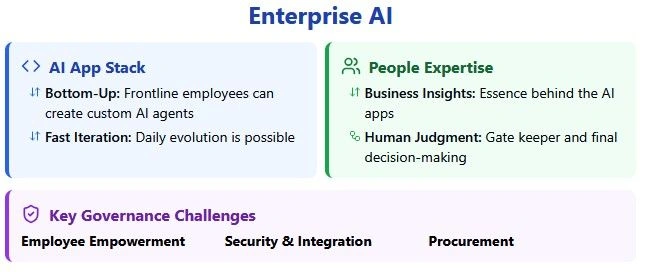
AI App Stack - Continuous iteration between your AI application stack and business operations.
People Expertise - Employees' expertise in managing and optimizing AI tools within daily workflows.
AI App vs. Classic Enterprise App
Bottom-Up Creation - AI tools, especially those built on Large Language Models (LLMs), empower frontline employees to create tailored AI applications and agents quickly and easily, even without coding knowledge. This customization ensures apps are closely aligned with specific operational needs.
Fast Iteration - AI applications can evolve daily, seamlessly integrating into business processes. This rapid adaptability enables organizations to respond swiftly to emerging market opportunities, unlike traditional software limited by long development cycles and infrequent updates.
Abundant Choices - In addition to internal development, the market will see a surge in vertical AI apps, often developed by smaller, more agile firms. These specialized developers typically possess a deeper understanding of domain-specific pain points and can iterate their applications at a much faster pace to address evolving business needs, offering a diverse and expanding array of solutions.
People Remain in the Driver Seat
As AI applications increasingly take over routine, low-value tasks, the demand for higher-order human skills—specifically, understanding AI capabilities and strategically applying them to business operations—will intensify.
Human Insights of Business - A solid understanding of the business context remains crucial for designing AI apps that execute tasks as intended and align with overarching strategic goals. For instance, different corporate philosophies—such as a company that is heavily data-driven versus one that is more ideas-centric—will necessitate distinct AI application stacks tailored to their unique approaches. A data-driven sales team might design an AI app to analyze CRM data for lead scoring and automate outreach based on conversion patterns, while an ideas-centric marketing team might leverage AI to brainstorm diverse campaign concepts and analyze sentiment around creative proposals. These differing AI strategies and implementations will naturally yield different operational outcomes and competitive advantages.
Human Judgment - While AI apps and agents can efficiently handle execution and even provide data-backed recommendations, humans must retain the crucial role of evaluating outcomes and making final judgments. This is particularly vital when dealing with complex, ambiguous situations or when ethical considerations are paramount. For example, an AI might identify a statistical correlation, but human expertise is required to determine causation, assess broader business implications, consider potential biases in the AI's output, and decide on the most appropriate course of action, ensuring that AI-driven decisions align with the company's values and long-term objectives.
Key Governance Challenges
Balancing Employee Empowerment - The integration of AI agents can lead to disparities in adoption rates among employees, potentially causing friction within teams as some eagerly embrace these tools to optimize workflows while others may be hesitant due to unfamiliarity or perceived risks. Moreover, the autonomous nature of AI agents raises concerns about unintended consequences impacting other colleagues or teams, such as data mishandling or process disruptions, especially when deployed without adequate oversight.
To address this, organizations can cultivate champion networks by identifying early adopters and tech-savvy employees, formally certifying them as “agent makers” or internal AI specialists, and pairing these champions with mentors from information security and compliance departments to ensure responsible innovation. Additionally, allocating resources for controlled AI pilots with mandated post-mortems on failures will create learning loops and refine best practices.
Ensuring Security and System Integration - AI agents' ability to operate autonomously necessitates robust governance structures to ensure alignment with corporate policies and regulatory requirements. Implementing sandbox environments for testing, establishing clear protocols for deployment, and ensuring data privacy are critical steps. Organizations must also consider the implications of AI agents accessing sensitive information and the potential for misuse or breaches.
Strategic responses include deploying "AI firewalls" and monitoring solutions to track AI tool invocations and data access in real-time for anomalies; adopting unified model architectures like LLM Mesh to standardize interfaces across vendor models, simplifying management and security; and establishing a comprehensive agent registry for all internal and external AI agents, logging functionalities, data dependencies, permissions, and version histories to ensure transparency and manage interdependencies.
Adapting Procurement Strategies - The proliferation of AI solutions has significantly expanded the vendor landscape, introducing numerous small to medium-sized providers offering specialized tools. This diversification challenges traditional procurement processes, which are often geared towards larger, established vendors and longer evaluation cycles. Companies must adapt procurement by developing agile evaluation criteria (assessing cost, functionality, security, compliance, and integration) and involving end-users to ensure solutions meet operational needs.
Strategic responses include adopting a portfolio approach for smaller AI vendors with a focus on security and responsiveness, enabling employee-led discovery vetted for data flow and rights, and using agile contracts with shorter renewals tied to auditability and model transparency.
Conclusion
As AI tools become more accessible and democratized, their mere adoption will no longer confer a significant competitive edge. True differentiation will lie in how organizations strategically leverage these tools to create unique value propositions and enhance operational efficiencies. Empowering employees to innovate responsibly with AI, supported by a flexible, adaptive, and secure governance framework, will be pivotal in navigating the AI transformation and maintaining a sustainable competitive advantage.